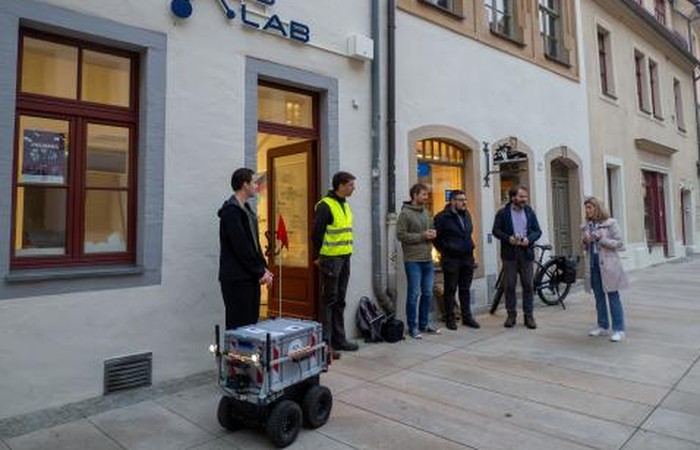
On 7 October 2026, the ROSEE delivery robot developed by the TU Bergakademie Freiberg undertook its first long-distance journey from Freiberg to Dresden. Over a distance of around 25 kilometres, travelling under its own power, the research team tested autonomous navigation under real-world conditions. The trial not only highlighted the challenges that dirt tracks, narrow passages and public road traffic pose for autonomous delivery robots, but also demonstrated how important testing outside the laboratory is for the further development of new technologies.
At 7.15 am, ROSEE set off from the RoboLab in Freiberg, seeing it off was TUBAF Rector Prof. Dr Jutta Emes. Accompanied by a research team from the Professorship for Software Technology and Robotics, the robot set off for Dresden at a speed of around five kilometres per hour. It navigated partly autonomously, recognising its surroundings and adjusting its driving style accordingly. When the evening rush-hour traffic became too heavy, ROSEE eventually joined the city traffic in the traditional way and took the tram all the way to Neustadt. At 6.50 pm, it reached its destination, the 4transferLab in Dresden.
Until now, ROSEE had mainly been operating on campus and in the Freiberg town centre. On field tracks, cycle paths and in rural villages, it now faced new challenges: it had to recognise hilly paths and grassy areas as navigable, correctly assess narrow passages and cope with roads without pavements. Where autonomous navigation reached its limits, the research team took over control.
Autonomous delivery and service robots could open up new possibilities for logistics, supply and services in the future, particularly in rural areas. Until then, however, legal and organisational hurdles must be overcome alongside technical issues: Where are such robots permitted to operate? What safety requirements apply? And how can authorisation be granted for their deployment?
Researchers and transfer specialists at TUBAF are working together to address these questions. Whilst the Professorship of Software Technology and Robotics is developing the technical foundations, the TUBAF Innovation Centre, together with the 4transferLab in Dresden, is bringing together local authorities, public administration and other partners to pave the way for practical testing and application.
The findings from the test run are being incorporated into the further development of ROSEE’s environmental perception and navigation. Another test is already planned for 2027. By then, ROSEE should understand its surroundings even better and, if possible, complete the entire route autonomously.
ROSEEs journey in pictures: You can find impressions and stops along the journey from Freiberg to Dresden here.